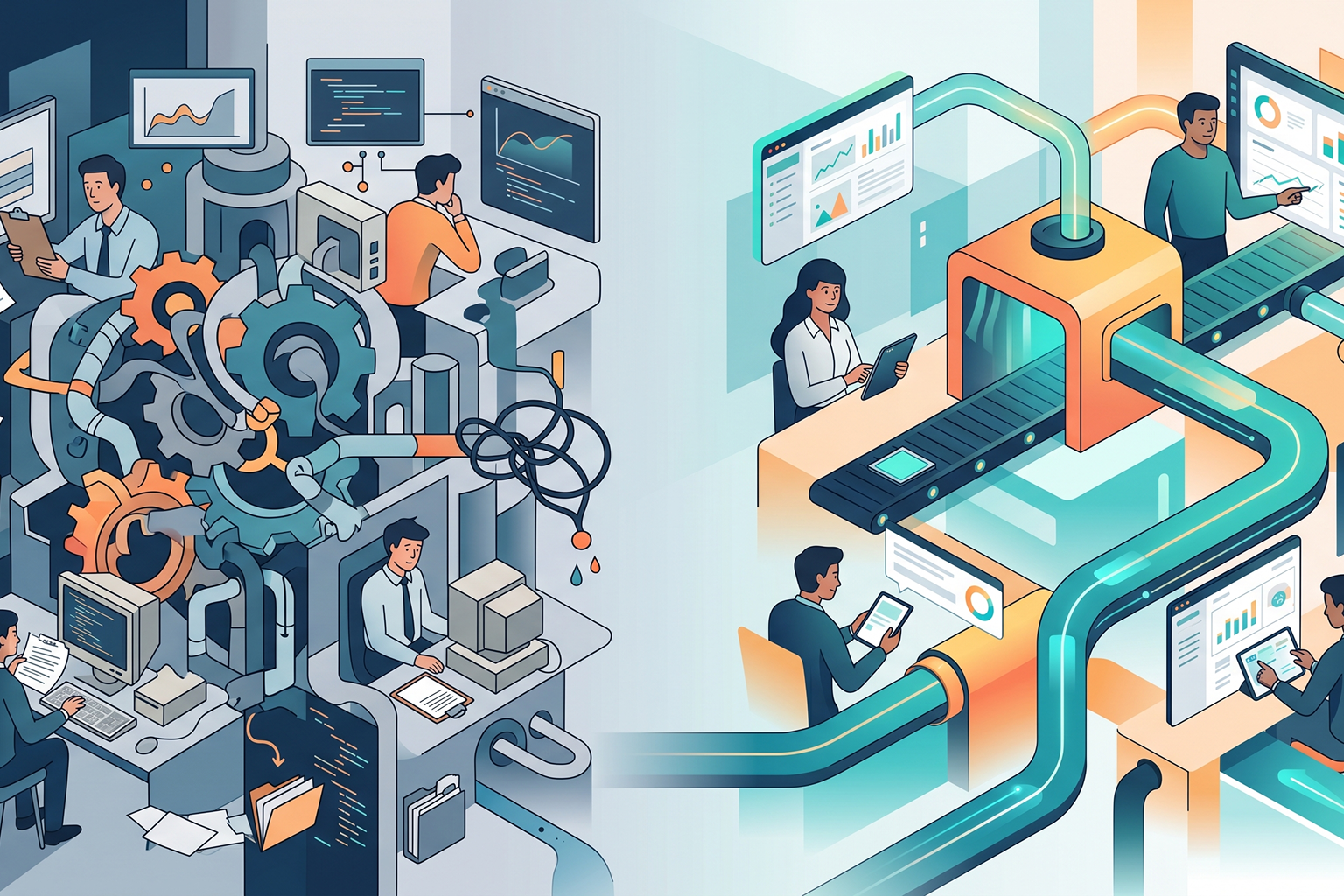
The most common misunderstanding about business digitization
A new ERP, a new platform, a new app, a new CRM. The initial feeling is often positive: at last the company is moving forward, work is being modernized, and a problem that has been left open for too long is finally being addressed.
And yet, a few months later, the picture is often far less linear than expected. The software is there, but people still rely on parallel files, some steps remain manual, and information is still scattered across multiple places.
In practice, the team works around the system instead of using it as the reference point, and the project that was supposed to simplify work starts producing a new form of complexity.
Business digitization is not a purchase: it is a transformation
This happens for a precise reason: business digitization is treated like a purchase, when it should instead be approached as a concrete transformation in the way an organization works.
The point is not to introduce a tool. The point is to understand how activities, data, responsibilities, and exceptions move through the real process.
If that work is not done first, even good technology can end up resting on a structure that has never really been understood. At that point, the software does not solve the problem: it simply covers it with a new interface.
The right question to ask before choosing any software
Before evaluating which platform to adopt or which software to implement, there is a more important question: which process needs to work better?
From there, everything else becomes clearer:
- Where delays build up and why
- Which steps are redundant and which are truly necessary
- Which information needs to be shared and with whom
- Where custom development is needed, where integration is enough, and where the issue is organizational rather than technical
Technology should arrive as the consequence of a clear reading, not as an assumption to defend at all costs.
Starting from the solution is the most expensive mistake in digital projects
When a company says "we need a platform" or "we need to build an app", it is already expressing a possible answer. But that does not mean it is the right one.
This approach requires more discipline in the early phase, but it avoids one of the most expensive mistakes in business digitization projects. Because reality is often simpler than it first appears:
- Maybe you need integration, not a new platform
- Maybe you need to reduce handoffs, not add features
- Maybe you need to redesign the flow before deciding which technology should implement it
Doing digitization well means exactly this: not adding layers, but improving the continuity of work.
The real signs of successful business digitization
When a project is set up correctly, the change becomes visible in concrete ways.
- People know where to work
- Data has a clear home
- Exceptions are reduced or handled better
- Teams depend less on informal handoffs
- Less time is spent reconstructing information
These are the real indicators of success: not the amount of software introduced, but the quality of the workflow that results from it.
Our approach to digitization at fabricators
For us, digitization does not mean bringing more technology into the company. It means observing real workflows, mapping needs, distinguishing between what should be built and what should be connected, and then developing in progressive steps so that each stage creates a measurable improvement.
We do not start from technology: we start from context, people, and business goals. No prepackaged solutions, no stacks chosen because they are fashionable. Only technology that stays sustainable over time, designed to last, grow, and adapt to the real needs of the organization.
Technology has value when it achieves something very simple, but very hard to obtain: making work clearer, more reliable, and more sustainable over time.
Everything else is just superficial adoption.