Integration is one of those topics that matters enormously in day-to-day work, but rarely gets talked about.
Perhaps because it lacks the surface appeal of new platforms. Perhaps because, when it works well, it tends to disappear: you don't notice it, it makes no noise, it simply lets everything else work better. Yet it is often precisely there that a significant part of business efficiency is created, or lost.
Integrating Doesn't Just Mean Connecting Two Systems
That is the visible part. The decisive part is something else: ensuring that data, events, states and responsibilities move from one point to another in a reliable, readable and sustainable way over time.
Integration has real value when it stops being a technical connection and becomes operational continuity.
- An order enters one system but gets re-entered elsewhere by hand: integration has not yet solved the problem
- Information exists in two different places and it's unclear which one is valid: integration has not yet solved the problem
- A department receives data that is theoretically available but too late to act on: integration has not yet solved the problem
The Right Questions Before Any Connection
Talking about integration seriously means going beyond the question "can it be connected?". The useful questions are different:
- What actually needs to move, and at what moment
- With what priority and with what frequency
- Which systems need to be the authoritative source for each piece of data
- How exceptions and inconsistencies are handled along the way
Only after this level of clarity does integration become truly useful. And it is only at that point that it's worth choosing how to implement it technically.
Where the Concrete Value Shows Up
When integration is set up correctly, the change is felt in everyday work:
- People stop spending time chasing down information
- Departments read the same reality, without diverging interpretations
- Decisions are made faster because the data is already available where it's needed
- Processes scale without multiplying invisible work
Those who do this well get something more than an orderly infrastructure: they get operational reliability, less dependence on manual checks and a greater capacity for growth without losing control of the flow.
Connecting Everything Is Not a Strategy
Not all integrations have the same value. Connecting everything with everything often only generates more complexity. The hard part, and the most important one, is understanding where integration genuinely creates an advantage and where it is better to simplify the process before adding connections to it.
This is why the right approach doesn't start from available connectors. It starts from real work: observing the flow, understanding the steps, reading the dependencies, distinguishing what is essential from what is secondary. This is the foundation for building integrations that are operationally useful, not just technically possible.
When Technology Stops Being a Series of Islands
When integration is built the right way, the effect is far greater than the sum of the individual connections:
- The company begins to operate with greater continuity
- Departments coordinate with less friction
- Data gains reliability and becomes a real asset
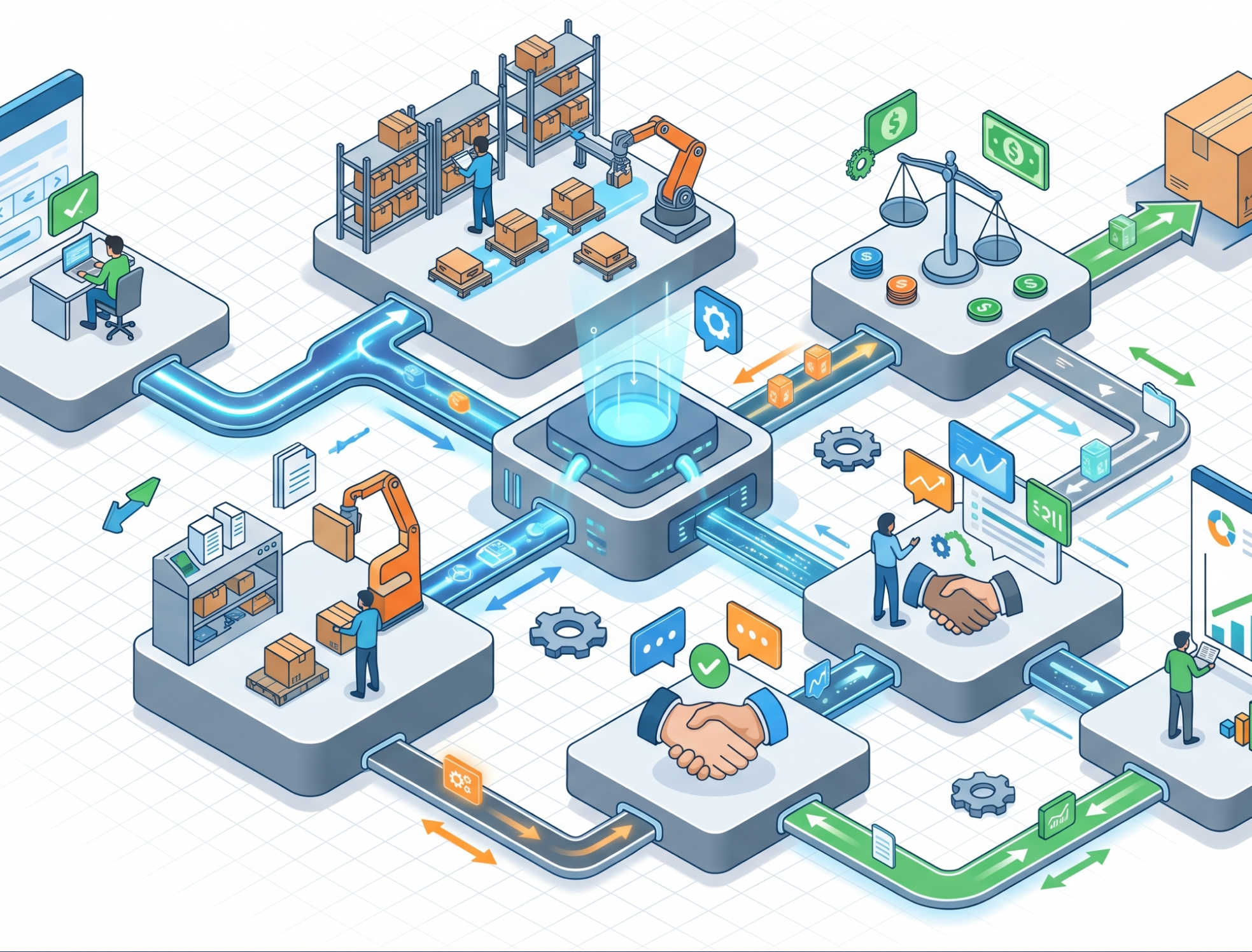
- Technology stops behaving like an archipelago of separate tools and starts functioning as infrastructure
That is when integration stops looking like an IT detail and reveals its true value: making work clearer, more reliable and more sustainable over time.
In fabricators we work at this level every day. We start from the real flow, read the dependencies and build connections that hold over time and not just in the demo.