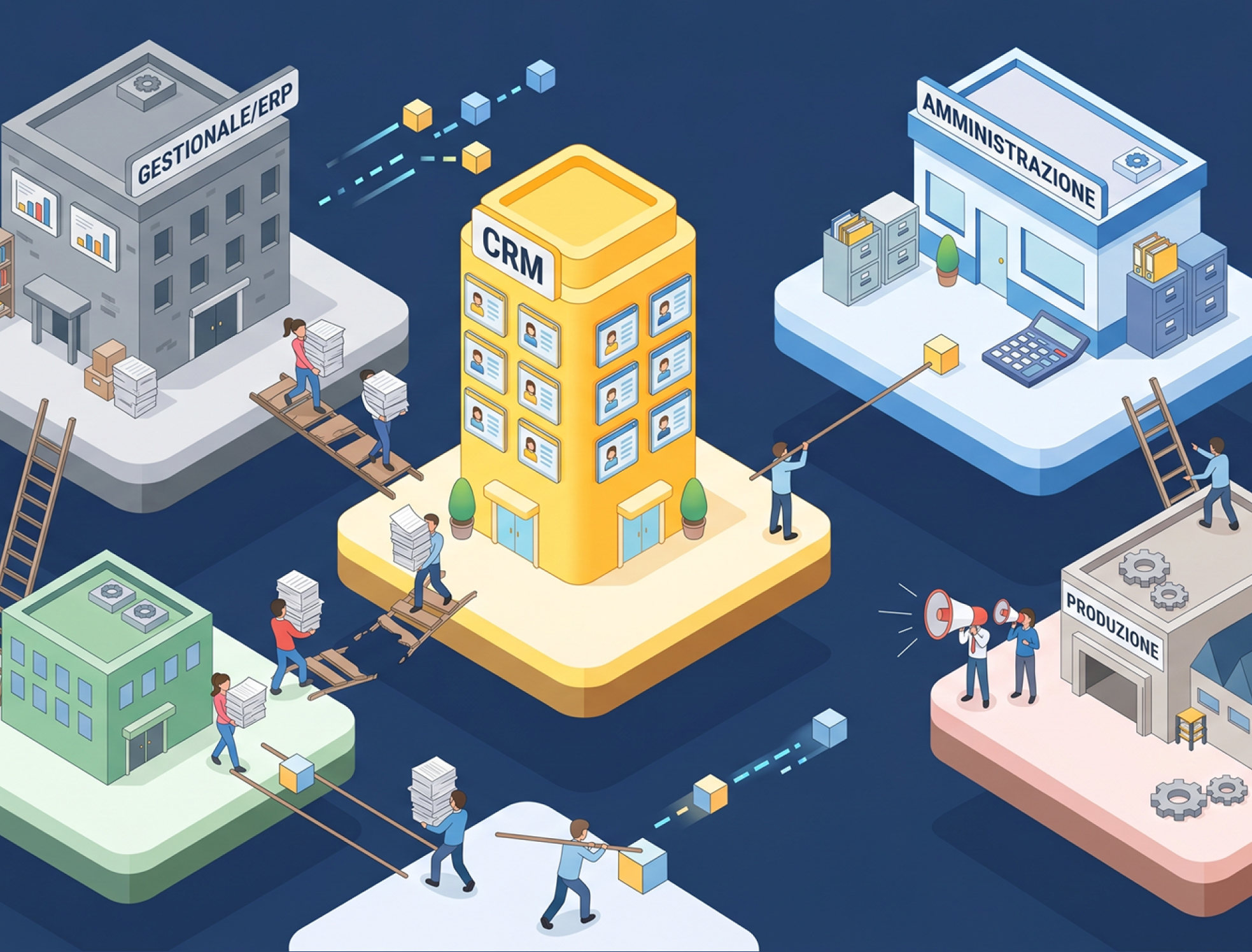
In many companies the software is already there. An ERP, a CRM, a system for administration, one for production, perhaps a portal, some separate reports, vertical tools introduced at different times to solve specific needs.
Taken individually, they are often even good tools. Yet work continues to be more complicated than it needs to be.
The Symptom Companies Recognise Too Late
When people copy data from one system to another, departments read different information about the same event and progress statuses get lost along the way.
Exceptions are handled by email or phone. And over time, operations depend more and more on individuals' ability to manually reconstruct what the infrastructure cannot keep together.
When this happens, the right question is not "which software do we need to change?". The right question is:
Why aren't the systems we have working as a system?
The Causes Are Almost Always Three
Software is adopted at different times, with different logic, by different business functions.
Each choice had its reason, but the problem arises when there is no overall design that establishes how data must move, which platforms must talk to each other, who is the reliable source of each piece of information and where exceptions must be handled.
Without this design, each new tool tends to add to the rest instead of organising it.
This is how the company begins to operate in overlapping layers:
- An administrative layer
- A commercial one
- An operational one
- One made of support files
- One made of manual checks that nobody has ever formalised, but that everyone knows they have to do
From the outside it might look like a technical problem. In reality it is almost always a mixed problem: technical, because the systems are not integrated well enough; organisational, because processes have adapted to the fragmentation; decision-making, because nobody has a complete view of how information should flow.
The Hidden Costs of a Fragmented Infrastructure
This situation produces costs that are rarely accounted for.
Not just errors and delays, but time spent verifying, clarifying, chasing, correcting, asking for confirmations, realigning departments and handling exceptions that should already be built into the flow.
Systems that do not talk to each other are not an IT detail. They are a business efficiency issue.
Understanding First, Then Acting
The interesting part is that, in most cases, there is no need to replace everything.
What is needed is to understand where the data originates, where it needs to go, how often, with what rules and which steps are currently compensated manually.
Only then can you decide, with sound judgement, whether to intervene with targeted integrations, middleware, automations, process revision or custom development.
The point is not to connect everything indiscriminately.
The point is to build reliable continuity between the systems that genuinely need to work together.
What Changes When Systems Start Working Together
When integration is set up correctly, the change is visible in concrete terms:
- Manual re-entries decrease
- Data becomes more consistent across departments
- Time spent realigning information decreases
- Handover errors drop
- The company reads what is happening more clearly, in real time
In other words, work stops depending on too many invisible reconstructions.
It is precisely in this space, between existing tools and real process, that the most concrete value of a technology intervention is often found.
At fabricators, we always start here: not from which system to add, but from how to make the ones already in place work together.